
Winnebago City Directory Shelves
Rockford Public Library is the central access point. Its genealogy page identifies selected open PDFs plus an in-library database run, while Local History adds indexes, maps, newspapers, and yearbooks. No source confirms that every year survives or is online, so the collection must be described by its documented routes.
| Collection | Years or run | Repository | Access method |
|---|---|---|---|
| Selected Rockford city directories | 1857, 1869, 1880 | Rockford Public Library | Free digitized PDFs |
| U.S. City Directories database | Rockford 1869–1960 stated | RPL Genealogy | Ancestry Library Edition in the library |
| Reverse directory series | Begins 1903–04; later editions continue | RPL and preservation sources | Library volumes and consultation |
| City directories and plat maps | Rockford history from the 1830s onward | Midway Village Research Library | Appointment or paid extended remote research |
| Historical government series | County records beginning in the 1830s | NIU IRAD | State Archives catalog, then repository request |
The gaps matter. A missing volume, an unlisted household, or remote access limits can explain a blank result. Ask library staff about the closest earlier and later editions before concluding that a person left Winnebago County.
Early Rockford Directory Years
The official preservation plan lists a printed sequence beginning in 1857, followed by 1859–60, 1866, 1869, 1872–73, and continuing runs. The 1857 Rockford City Register includes a street section that describes endpoints from the river or named cross streets. It is both a city directory and a guide to the early grid, which cannot be laid over current GIS without checking later maps.
The digitized 1869 volume supplies name, business, and address context. The 1880 Matthews’ Rockford City Directory names W. F. Mathews as publisher and offers a detailed transcription key. It places residents, boarders, teachers, salesmen, public offices, newspapers, shops, and factories in one alphabetical system. Those business links are especially useful in an industrial city where a firm entry can explain a person’s work address.
Follow the RPL genealogy instructions: in the library catalog, choose U.S. City Directories 1821–1989, then browse Illinois, the city, and year. This is a library database path, not proof that every edition in the span is present.
Read Winnebago Directory Entries
The 1880 volume shows how much meaning can sit in a short line. One household appears in several entries at the same Second Avenue address, while another person is marked as boarding on Kishwaukee. A firm can have its own street number, and “same” can refer back to the address in the prior related entry. Always consult the volume’s own key because abbreviations change by publisher and year.
| Name | Surname, given name or initial, sometimes with a family or firm connection. |
|---|---|
| Work or firm | An occupation, employer, business name, or public role as printed at that date. |
| res. | Residence, followed by the historical house number and street. |
| bds. | Boards, indicating lodging rather than ownership. |
| same | The preceding related address, which must be read in context. |
| wid. | A widow marker that may lead to death, probate, or newspaper research. |
Do not modernize a spelling in the transcription notes. Preserve the printed form, then add a normalized form beside it so the same person can be tested in another year.
- Criss-cross directory
- A section ordered by street and house number rather than by surname.
- Householder index
- An address-oriented list that points from a household location to the named entry.
- Abbreviation key
- The publisher’s explanation of short forms and symbols used in that edition.
- Directory year
- The publication date, which may not equal the exact date every entry was collected.
Rockford Reversed the Directory
The 1903–04 edition is the first Rockford reverse directory by street identified in the Historic Preservation Plan. Later editions continued that useful address route. Before then, most searches start with a surname, although the 1857 book’s street descriptions and the limited 1890 Philippi’s Rockford Blue Book add address context.
A reverse section changes the question from “where did this named person live?” to “who was printed at this address?” It is ideal for a house-history lead, yet it remains a dated publication. Check the alphabetical entry for work and household clues, and compare the editions on both sides of the target year.
The history also marks a change in how residents could be found. Use modern parcel tools for a current address workflow on the Winnebago County street directory page; use printed reverse volumes for the past.
1893 Changed Rockford Addresses
Rockford street numbers changed in 1893. The South Main limestone-building record gives a rare concrete bridge: old 15/17 and 19/21 references became 118/120 and 122/124. This quirk can split one building across three practical forms in catalogs, directories, maps, and current descriptions.
Search both number systems. Pair the city directory entry with the Rockford Historic Preservation Plan, a Sanborn sheet, a cross street, and the parcel’s legal description. An apparent move in 1893 may be a renumbering rather than a change of home. Note: Keep the old number exactly as printed because it is the search key for newspapers and early maps.
Use Rockford Local History
Rockford Public Library Local History extends far beyond directories. Its death index runs from 1844 through 1981, the birth index from 1855 through 1931, and separate marriage indexes cover brides from 1835 and grooms from 1836 through 1956. These are public research leads, not certified vital records. Historical newspapers and predecessor titles reach back to 1871, while local abstract projects cover obituary, death-notice, and marriage references from 1840 through 1869.
The Main Library is at 215 N Wyman Street in Rockford, with phone 815-965-7606. Staff can be reached through localhistory@rockfordpubliclibrary.org. Hours and research space can change, so contact the desk before a visit. HeritageHub requires a library card, and Ancestry Library Edition is an in-library route. HeritageQuest supplies historical federal census access.
The library collection page pictured below is the successful manifest source for this city directory page.
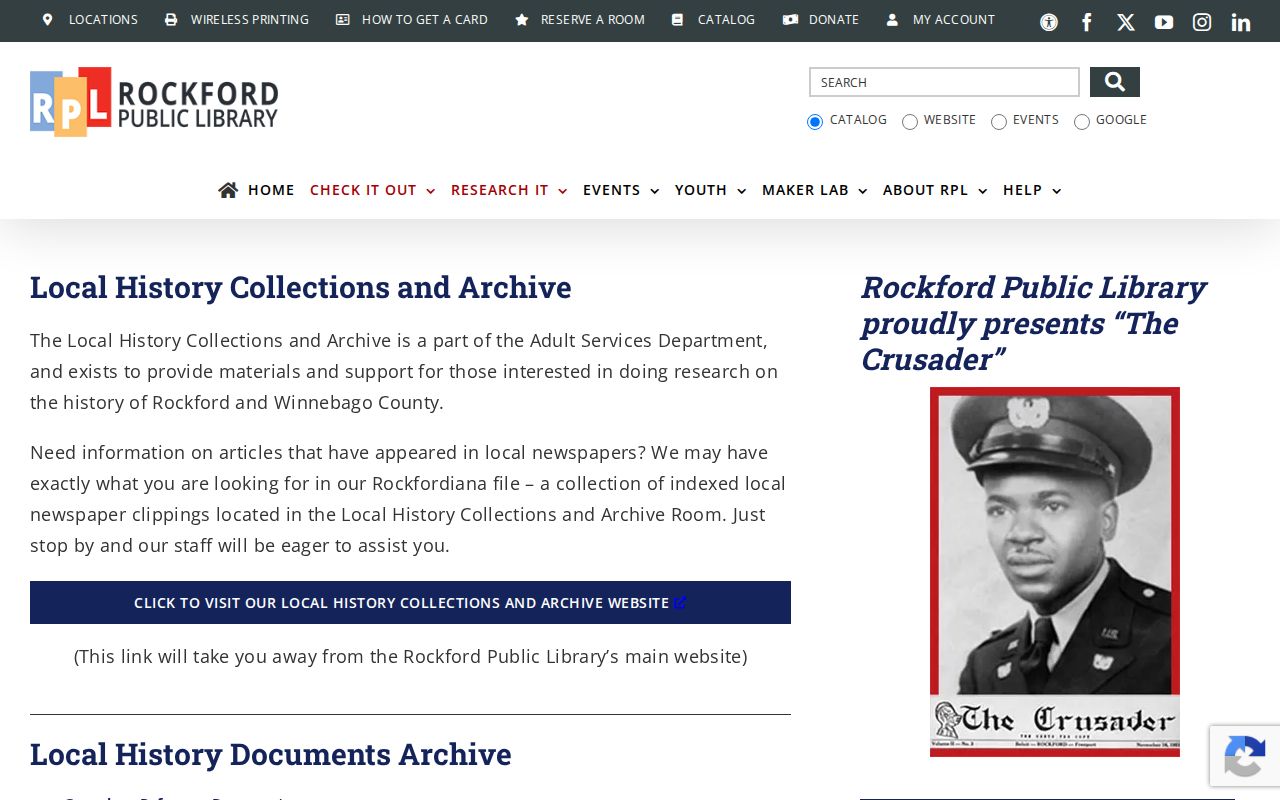
The page anchors the printed shelf to companion sources, so a name can move from an address book to a newspaper, index, yearbook, map, or local-history file.
Map Winnebago Directory Addresses
Sanborn fire-insurance maps help explain the place behind a printed line. UIUC lists Rockford sets for 1887, 1891, 1897, east and west sections in 1913, 1919, and 1923, plus later microfilm years. The digitized 1887 item records building and block numbers, property boundaries, construction, openings, water facilities, and some commercial or factory uses.
The Library of Congress 1887 Rockford set offers 15 images. Coverage centers on urban and commercial areas, so a rural county address may be absent. A Sanborn sheet describes structures and land use, not a complete resident roll. RPL maps from 1859 and 1902, yearbooks beginning in 1892, and the Rockfordiana clipping file add other ways to place a name.
Three Winnebago Research Desks
When the RPL city directory run stops short, three repositories offer different kinds of help. Give each desk a surname, address, date range, and the source already checked. A focused request is more useful than asking for everything about a family.
Midway Village
The Research Library holds directories, plat maps, organization and business files, and more than 15,000 photographs and postcards. Visits require at least 24 hours’ notice. Remote work is free for 30 minutes, then $15 for the first hour and $13 for each extra hour.
NIU IRAD
The State Archives county inventory names deeds, mortgages, court, probate, voter, school, jail, tax, military, coroner, and plat series. Search the catalog first, then ask NIU about access.
County Genealogical Society
The Winnebago and Boone County Genealogical Society identifies local indexes, microfilm, newspapers, histories, directories, cemetery material, and naturalization-card leads. It warns that many births and deaths before 1877 were not recorded consistently.
None of these descriptions means every item is digitized. An appointment, email, archival request, or in-person review may be the only channel for a particular year.
Winnebago Directory Milestones
The publication history fits into a broader county records timeline. Winnebago County began in 1836, with the county seat in Winnebago until 1839 and in Rockford since then. Preserve township-name variants too: Cherry Valley, Durand, and Winnebago replaced earlier township names around 1869.
| Date | Directory or record milestone |
|---|---|
| 1836 | County government begins; IRAD deed and marriage-license series start. |
| 1857 | Confirmed Rockford City Register and street section appears. |
| 1869 | A digitized directory year overlaps township-name changes. |
| 1880 | Matthews’ directory provides detailed name, work, firm, and address entries. |
| 1893 | Rockford changes its street-number system. |
| 1903–04 | The first confirmed Rockford reverse directory by street appears. |
| 1960 | End of the stated Rockford run in RPL’s in-library directory database. |
This timeline is not a claim that every intervening book survives. It shows why archive books, printed directories, maps, and modern portals occupy different parts of one research trail.
Trace Winnebago Families by Year
City directories are strongest when treated as a series. One line offers a lead. Repeated entries reveal a pattern of addresses, work, spouse references, widow marks, or firm ties. Pair that pattern with public census years and a local death or newspaper index.
- Choose a known surname or address and the closest confirmed directory year. Record initials, spelling, abbreviations, and page.
- Inspect every same-surname entry. Check both an individual listing and any linked business entry.
- Move one edition earlier and later. Record changes without assuming absence means death or departure.
- After 1903–04, use the reverse section to test the address. Before 1893, test the former number and map location.
- Pair the sequence with a public federal census. The 72-year rule currently opens schedules through 1950, while 1960 is due in 2032.
- Close the trail with an RPL obituary or event index, newspaper notice, probate file, deed, or cemetery record.
A city directory can distinguish a residence from boarding and can name an old occupation or firm, but it cannot prove kinship by itself. Census, vital, probate, and deed sources were made for other purposes and supply the needed cross-check.
Winnebago City Directory Limits
Printed directories omit people. They may use initials, maiden or married names, widow marks, old spellings, and short street types. The publisher may have missed a household, or the person may have moved while the edition was being prepared. An optical text search can also fail on worn type. Browse the surname pages and street section when keyword search returns nothing.
RPL’s open PDFs, in-library databases, staff contact, Midway appointment service, genealogical society resources, NIU IRAD catalog, newspaper archive, maps, and census sources are all documented channels. Use the source that fits the year and question. Do not treat a modern people-search compilation as a substitute for the printed page and its date.
A directory entry should be cited with the city, publisher when known, year, page, and repository. That makes the finding repeatable and keeps a historical Rockford resident from being confused with a current Winnebago County resident.