
Winnebago Address Records by Era
A backward address search works best as a dated source ledger. Winnebago County deeds establish recorded ownership, while tax and assessment portals provide the modern PIN, the parcel identification number used across county systems. Rockford directories and census schedules can supply household names. Maps confirm that a building, lot, or old street number existed, but do not prove who occupied it.
| Source | Years Covered | Where Held | What It Shows |
|---|---|---|---|
| Deed record | 1836–1891 in IRAD | NIU IRAD and State Archives inventory | Historic grantors, grantees, and deed books; web images are not assured |
| Mortgage record | 1845–1918 in IRAD | NIU IRAD | Named borrowers and land obligations |
| Current Recorder index | Online cutoff not stated | Direct Search, Tapestry, Laredo, and office | Recorded instruments and legal descriptions |
| Assessment and tax history | Through 2003 stated | Assessor and Treasurer portals | Parcel and taxpayer clues, not every occupant |
| Rockford directories | 1857, 1869, 1880 PDFs; 1869–1960 library run stated | Rockford Public Library | Names, addresses, work, firms, and household shorthand |
| Reverse directories | First listed for 1903–04, then later editions | RPL and preservation-plan collections | Address-to-name searching |
| Sanborn maps | 1887 through 1972 holdings | UIUC, Library of Congress, and local referrals | Buildings, lots, block numbers, use, and construction |
| Federal census | 1790–1950 public | National Archives and library databases | Households at a past date under the 72-year rule |
The right first source depends on the date. Start online for the current parcel, but expect the trail to move to a public terminal, mailed request, microfilm, or library shelf. The Winnebago County IRAD finding aid identifies the confirmed early series.
Anchor Winnebago Previous Residents to a PIN
Enter the present address in the Supervisor of Assessments Parcel Details Inquiry. Its form accepts four PIN segments, separate location number, direction, street and suffix fields, plus owner last and first name. Keep the situs address, which means the physical parcel location, apart from any taxpayer mailing address. A mailing address may belong to a trust, business, agent, or owner who receives mail elsewhere.
Then open WinGIS property search to compare geometry, boundaries, nearby streets, and map layers. When the PIN is known, WinGIS Parcel Summary is the direct route. Record the legal description as well as the PIN. That description, usually a lot, block, subdivision, or metes-and-bounds statement, is the strongest bridge when a street number changes or a parcel splits.
- PIN
- The county parcel identification number.
- Situs address
- The physical parcel location, not an owner’s mailing address.
- Legal description
- The land description used to match deeds when street labels fail.
Note: An assessment exemption may suggest owner occupancy, but it does not identify every person who lived at the address.
Follow Winnebago Deeds Backward
The Winnebago County Recorder records land transfers, not a complete roll of previous residents. Still, a deed chain supplies the legal backbone of house history. “Grantor” means the party transferring an interest; “grantee” means the party receiving it. A chain of title is the linked sequence of those transfers.
- Save the current PIN, situs address, legal description, and owner exactly as the parcel record shows them.
- Use the Recorder’s free Direct Search, or its paid Tapestry and subscription Laredo routes, to search that owner as grantee.
- Find the acquisition deed. Match its PIN or legal description before noting grantor, grantee, date, document number, and earlier references.
- Search that grantor as an earlier grantee. Repeat, checking the land description at each link.
- If an estate, trust, corporation, split parcel, or condo appears, follow its exact recorded name and related record.
- When online results stop, contact the office, use its public station, request a book or page copy, or move to IRAD.
Do not assume the web index covers a particular year. The county does not state its current online cutoff. Recorder staff can perform a party-name search, but the office says it does not accept telephone searches. Search and copy routes carry different fees, so identify the record before ordering.
The Recorder FAQ documents the public-station and history-search guidance.
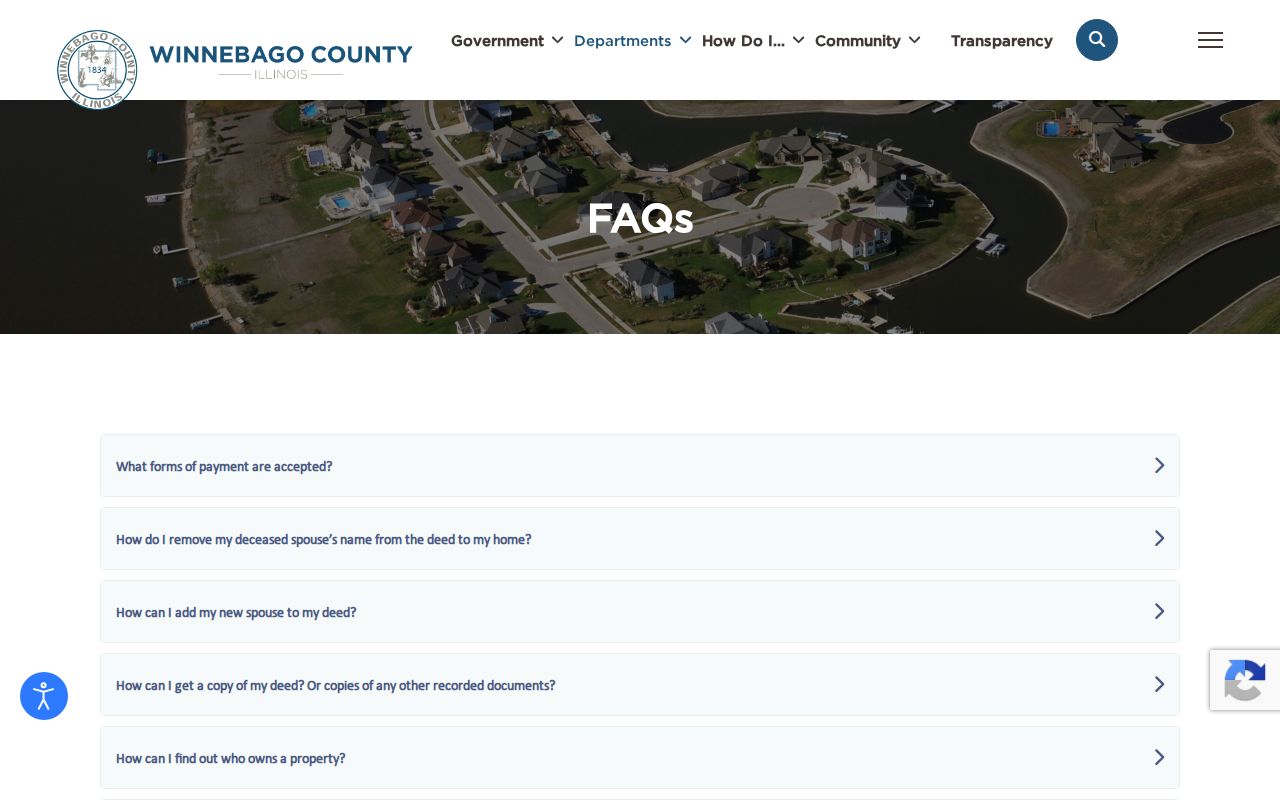
The captured page reinforces why a previous-resident search should separate free index work, office research, and formal copy orders.
Where Winnebago Address Records Leave Web
Older records require a fallback chain. The State Archives local-government inventory lists Winnebago deed records for 1836–1891 and mortgage records for 1845–1918 at Northern Illinois University’s IRAD depository. An inventory entry says a series exists. It does not mean every name, page, or image can be searched online.
Ask the Recorder about an unindexed year, public-station access, a book and page search, and the correct copy form. For early material, give IRAD names, an approximate date, township or place, and any legal description already found. Winnebago was the county seat from 1836 to 1839; Rockford became the seat in 1839. That short shift can affect how early references are labeled.
Research tip. Keep the exact source, search date, and whether you saw an index entry, image, or certified copy.
Winnebago Previous Residents Face 1893 Numbers
Rockford changed street numbers in 1893. That local quirk can make previous residents appear to vanish between a deed, directory, and modern parcel search. The Rockford Historic Preservation Plan supplies the date and identifies the directory and insurance-map sources needed to bridge the change.
A documented South Main example makes the problem concrete. Buildings once numbered 19/21 and 15/17 later carried 122–124 and 118–120. Modern references can simplify those ranges again. Never convert an old address through a generic rule. Match the old number in the 1857, 1869, or 1880 directory, locate the building on an 1887 or 1891 map, then compare its lot and parcel shape with the current legal description.
Note: Preserve the printed number and street spelling even after finding a modern equivalent.
Pair Winnebago Resident Directories and Census
Deeds reveal owners. Directories and census schedules are better for past residents who did not hold title. Rockford Public Library provides open PDFs for selected 1857, 1869, and 1880 directories and states that Ancestry Library Edition in the library includes Rockford city directories from 1869–1960. The 1903–04 volume is the first reverse directory by street identified in the preservation plan.
Use the collections without turning a missing entry into a conclusion. A person may appear under an initial, variant spelling, firm, or spouse. “res.” marks residence, “bds.” signals boarding, and “same” points to the prior address. Full coverage is not promised for each year.
- Search the address in a reverse directory year, or the surname in an earlier name-first volume.
- Move one edition at a time. Record the exact name, address, abbreviation, and year.
- Compare a nearby public census year. Federal personal schedules through 1950 are open.
- Use the census household as a dated check, then return to later directory years.
- When 1893 interrupts the sequence, bridge it with maps and the legal description.
The Winnebago County city directory collections page covers the shelves and printed entry keys. Here, their role is narrower: testing who lived at one address between land transfers.
Map Winnebago Previous Residents’ Buildings
Sanborn fire-insurance maps help date the physical setting. UIUC lists Rockford sheets for 1887, 1891, 1897, east and west 1913, plus 1919 and 1923 updates. Later microfilm holdings include 1957, 1963, 1966, and 1972. The Library of Congress 1887 Rockford set is an official image route.
Sheets can show property boundaries, house and block numbers, construction, openings, water facilities, and commercial use. They do not name all past residents. Coverage centers on urban areas, so rural Winnebago County addresses may be absent. Use a map to confirm the building and number system, then use a directory, deed, or census to attach a person.
Winnebago Previous Residents Research Help
The Rockford Public Library Local History collection combines directories, 1859 and 1902 maps, newspapers, yearbooks, the Rockfordiana clipping file, and local histories. Staff consultation helps when a prior number or building name cannot be placed. Some digital items are open, while database and on-site resources have their own access rules.
Midway Village Museum adds plat maps, directories, more than 15,000 photographs and postcards, plus building, resident, and organization files. Its research library is appointment-only with at least 24 hours’ notice and no walk-ins. In-person research is free. Remote help is free for 30 minutes, then costs $15 for the first hour and $13 for each added hour. Give staff the old and current address, cross streets, PIN, or building name.
A narrow request gets better results. Historical building-permit coverage was not found in a stable public search, so the city permit office or an Illinois FOIA request is the fallback for releasable address-keyed files.
Close Winnebago Previous Residents Gaps
A death notice, probate petition, or estate deed may explain why a name leaves the address trail. RPL’s death index spans 1844–1981, and its bride and groom marriage indexes reach from the 1830s through 1956. These are leads, not certified certificates. Newspapers may add relatives, a funeral home, church, or old address.
Use the Circuit Clerk or IRAD for probate and the Recorder for an estate deed. Compare each relationship and address with the authoritative file. An obituary residence may have been reported by family or an editor, so it cannot replace a deed or parcel record.
Lawful use. Trace previous residents for family history, estate work, or responsible house research. Never use address records to watch, threaten, or harass anyone.
Previous residents are best supported by agreement between two dated sources. Label an owner as an owner, an occupant as an occupant, and a relative as a relative. That care preserves the real history of a Winnebago County address without claiming more than the records show.